Our main tools
Python
Python is one of the most popular programming languages thanks to its simplicity and readability, as well as its vast ecosystem of libraries and frameworks. As it excels in data analysis, machine learning and automation, it is one of the most used languages in our group. We use Python to develop tools that support many stages of our characterization workflow, from generating thousands of virtual waste items to processing measurements and applying machine-learning models. The combination of flexibility, automation and a large scientific ecosystem allows us to turn complex calculations into reproducible workflows.
R
R is another programming language we extensively use in our group. It is specifically designed for statistical computing and data visualization and provides a rich collection of packages and built-in functions for tasks such as data analysis, machine learning and hypothesis testing. We use R to explore and understand the large datasets generated by our simulations and measurements, identify patterns and relationships and turn large amounts of characterization data into visual and statistical evidence that can guide the development and validation of our methods.
ActiWiz
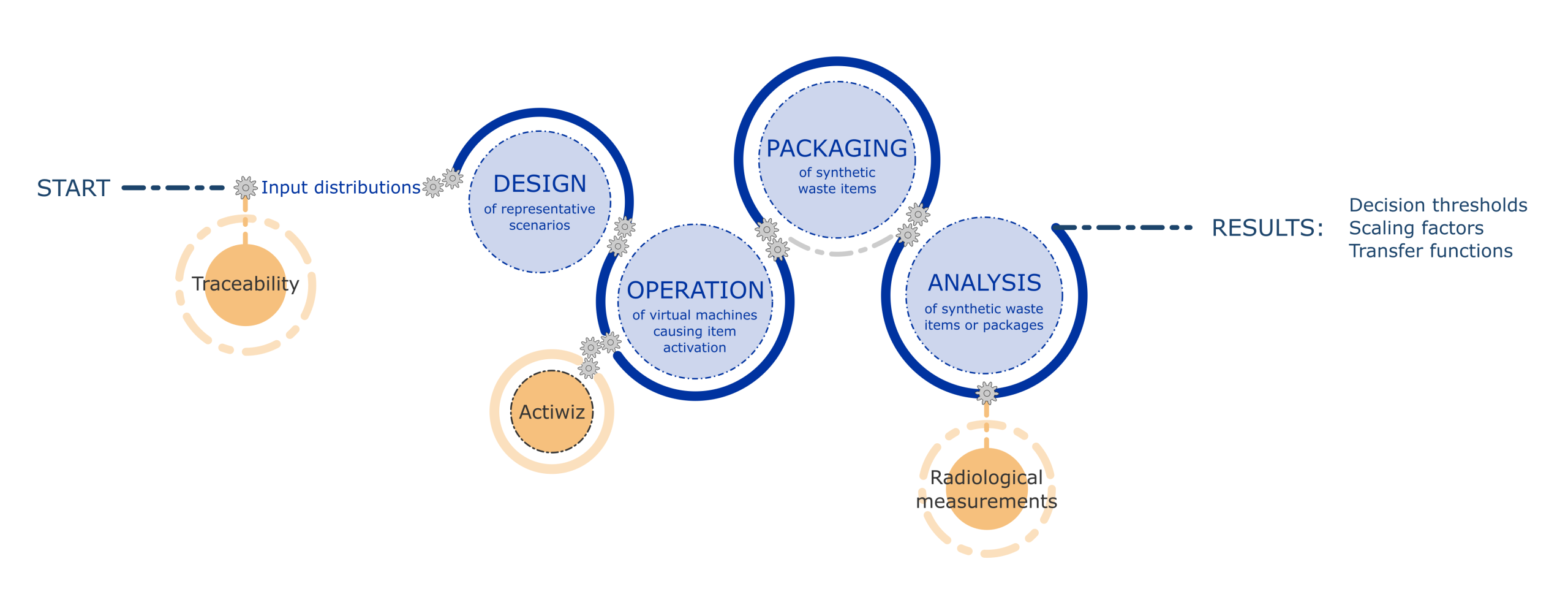
ActiWiz is an analytical code developed at CERN in 2011. It is based on simulated particle fluence spectra together with a dedicated decay engine and user-defined input parameters.
The aim of ActiWiz is to compute quantities related to the activation of an object inside a CERN accelerator.
The basis of ActiWiz is the definition of a scenario that specifies the physical characteristics of an item as well as its radiological history parameters. It can then calculate the induced activity values for all radionuclides present in the item, as well as the item’s average dose rate at a user-defined distance.
FLUKA
FLUKA is a powerful simulation software used for particle transport and interactions with matter. It’s widely used and finds applications in fields ranging from High Energy physics to medical physics and dosimetry. In our group, we use FLUKA to simulate the beam losses that lead to material activation. In this way, we produce the particle fluence spectra needed to run ActiWiz. We can also use FLUKA directly to calculate dose rates or radionuclide inventories for specific waste items.
Machine learning
Machine learning teaches computers to solve statistical problems by using experience gained by looking at hundreds or thousand of examples and learning from them. We can take advantage of such methods to study our numerous virtual waste items, for example using linear regression to calculate scaling factors or logistic regression to predict the classification of a waste item as clearance candidate vs radioactive.
An advantage of creating thousands of scenarios and studying them through machine learning techniques is that we can quantify the performance and uncertainties of our methods.
Neural networks
Neural networks are a specific type of machine learning method inspired by the way networks of neurons process information. They learn to recognize complex relationships by looking at many examples and adjusting their internal parameters to reproduce the patterns found in the data. Unlike simple statistical models, neural networks can capture non-linear relationships involving many variables at once. We can take advantage of such methods to study our numerous virtual waste items or by building fast surrogate models of our activation calculations.